Showing posts with label ecology. Show all posts

Saturday, 11 October 2014

To bee or not to bee...

 
We've been enjoying some late brassicas as our spring greens, as the purple sprouting broccoli and Romanesco cauliflower become ready. Unfortunately for me, this means other plants in that family have given up growing leaves and have turned their attention to flowers in the heat, including our kale and rocket.


This year, it's actually been really exciting rather than disappointing to see this happening. Beauty is in the eye of the beholder after all! The flowers are edible and make a pretty garnish to a salad or stirfry, but it's the wider effect of the flowering that's really drawn my attention.


I've been doing some beekeeping research since my birthday in July, when we decided that bees would make a great addition to our home and garden. Thankfully there is a beekeeping shop and club nearby in Newcastle, but as luck had it, on the day we ventured out to buy our hive, the shop door closed right as we drove in. Not deterred, we went to a local bookshop and found a book on the subject instead. Here is where things got interesting, as I soon realised this was a major undertaking including checking the hive fortnightly (involving a full bee suit and smoker) and processing huge amounts of honey at just the right time... not to mention the fact that we're in a normal suburban street with neighbours on either side and swimming pools to deal with. Once I got to the section about swarms and stings I was pretty intimidated, but thought I might check out the Hunter Valley Amateur Beekeepers website for inspiration. There I found links to information about stingless bees, and all my problems were solved.


The Upsides:
 
1. Environmentally friendly
These stingless bees are Australian natives, and the species we are getting lives naturally in this area. This means there are no concerns about introducing more European bees into the area and the various problems they bring.
 
 
2. Low maintenance
It's best not to open your hive at all, except a year or two down the track if you want to split them to create more hives.


3. NO STINGS!
Just in case you missed the point earlier! Apparently they can bite you with their little jaws, but it's only if the hive is disturbed and not nearly as painful as a sting. This means no bee suit, no smoker, and no cranky neighbours.
 
 
4. Fewer pests and diseases
Many of the pests and diseases affecting European honey bees are not an issue for these little fellas, so you don't need to constantly be checking their hive. They are excellent guards, so many pests attempting to enter the hive are destroyed.
 
Tetragonula carbonaria (note the white fuzzy face)
 
The downsides:
 
1. Sensitive to extreme temperatures
The European honeybee can live and function at both higher and lower temperatures than many of the native bees. Tetragonula carbonaria are the species most commonly kept, and I wasn't sure they would survive here due to the cold winters. You can imagine my excitement when I saw them feeding on our rocket and kale, as they only forage 500m from the nest, that means they are alive and well, not far from here!


2. Lower honey production
European bees are so popular for their epic honey making ability, which outperforms the native bees by many times. A stingless bee hive may produce 1 to 1.5 kg of honey per year, provided the temperatures are suitable and there are plenty of flowers to collect honey and nectar from. This pales in comparison to honeybee hives, but is also more convenient to collect and process.
 
I'm convinced that they're a much better option for us, and we've ordered our first hive!
 
We attended a workshop this week with Tim Heard and Tony Goodrich to learn about the bees and how to keep them, and were all the more excited and inspired to meet our new 'pets'. Pictures were taken on a phone, so apologies for the quality, but that spiral hive is such a beautiful creation.
 
Tony demonstrating splitting a Tetragonula carbonaria hive.
 
 The top half of the hive
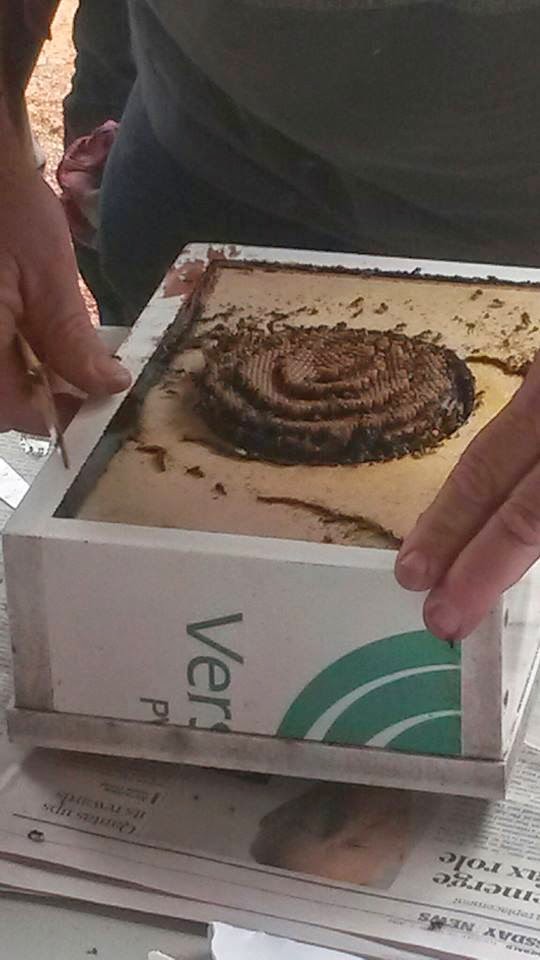
 
 The bottom half
 
If you're inspired (and I hope you are!) Tim's website is full of great information, and his workshop was invaluable. John Klumpp's book Australian Stingless Bees also has lots of great information, and I highly recommend it.

Now to find the perfect place for our hive while we are waiting for it to arrive!

Tuesday, 23 September 2014

Because weeds are flowers too


I've studied a bit of weed science and have always found it funny that it's near impossible to define a weed beyond 'a plant growing in a place it was not intended'. The dandelion for example, is a plant with edible leaves, bright flowers that attract and feed insects, and a strong tap root that helps to aerate compacted ground.
Not to mention the joy it brings to children (and adults like myself), blowing the seeds and making wishes...
What a thing of beauty! Such a shame that we chase them out of our gardens...
And don't get me started on clover chains.
 
(PS I say this with full disclosure that I sprayed my Bindiis a few weeks ago, but they are a whole other creature).
 
1

Saturday, 19 April 2014

Photo of the week - Lady and the tramp


In amongst my vegetables, there are lots of little creatures going about their day. Just a little bit of patience is all it takes to get a glimpse into their busy world. My favourites to watch are the lady beetles, members of the family Coccinellidae. They are all rounded, most are yellow,orange or red, and have a number of spots on their wing-covers. In my garden, there are 2 common types: the small orange beetles with 2 large black blotches, and the larger yellowish beetles with many small spots.
 

Coccinella transversalis
 
"28-spotted Ladybeetle" Epilachna sumbana

The first is a friendly little fellow, and seems to hang about feasting on the occasional aphid or scale, or the mildew that grows on the leaves of my zucchini and squash. The second actually eats the leaves themselves. My simple rule of thumb for ladybeetles is: A few spots is good. Lots of spots is bad. If in doubt, I tend to think of Cruella DeVille. Even the babies don't look as friendly! See:


I'm sure in this case you can guess which is the unfriendly visitor just by looking, but if you were in your own garden, just have a look what they're doing. Beetles go through a number of larval stages so it's sometimes difficult to tell who is who, but the tell-tale scraping marks on the leaf are a good sign that this is a leaf-eating beetle.
 
The good news is that in general, they don't eat much. I don't spray the 'bad' insects at my place for fear of scaring off (or killing off) the good ones. If you have a healthy balance in your garden, a few nasty beetles aren't an issue and will only result in a few unsightly half-chewed leaves. Their populations can boom quickly if the weather is right, but birds generally catch up pretty quickly. I have a few larger shrubs and trees growing between the veg for insect hunters to gather in, and as they grow I'm seeing more birds all the time. As always, variety is the key!
 
 
And for those that are curious, my apple tree is still flowering away... sigh...

Tuesday, 31 December 2013

December is for...seeking out the mistletoe

It's New Year's Eve, and I've been lurking around at the local pigeon club. Not because I'm into pigeons, they're not really my thing. More because they have the biggest Silky Oak in the street, and it's host to a number of big, healthy mistletoes. And I've struck gold...


But I've already missed Christmas, you say. No, I'm not collecting mistletoe in order to get extra kisses, although it might be a tradition worth encouraging in Australia. From what I can tell, the Europeans are winning in the mistletoe respect stakes, but I've become quite intrigued by it in the last few years. My inner ecologist is delighted, my inner horticulturist is horrified. Horticulture training recommends the removal of mistletoe from trees and shrubs as quickly as possible, as they can cause water loss and death in some cases. These clever plants are considered parasites, but I prefer to think of them as piggy-backers. When a seed germinates on a branch, the root grows into the host plant and proceeds to live off its water and nutrient supplies instead of growing its own root system and getting these from the ground the old fashioned way. The downside for the generous host is that in general, mistletoe is greedy and wasteful, allowing water to escape from the leaves that is normally trapped carefully by waxy cuticles and closed pores.


But it's not all bad news... mistletoe berries are an important food source for Mistletoe Birds and  the nectar is a nutritious food for Painted Honeyeaters, among others. I wouldn't mind having some of these sweet birds visit my backyard, and so I decided to try and infect (or introduce) some mistletoe into my plants. Until today, that wasn't as easy as it seemed. You can't simply transplant it, as it's anchored into another plant... so the only option is to plant a seed. Again, not so easy, as the berries are eaten by well-meaning birds and spread all over the place. I've been watching the whole process, as the flowers opened a few weeks ago, and the berries have now followed. Imagine my excitement in finding some berries on the ground under a bottlebrush tree in my street! But if I'm realistic, I know the seeds will germinate much better if they have been pre-digested by a helpful feathered friend.


Hence the visit to the large Silky Oak tree. There are so many mistletoes here that the birds hang around for ages, depositing their packages of seedy goodness as they feed and play.


I graduated from my horticulture degree this month, and 6 years ago I'm sure I wasn't imagining collecting bird poo from the ground when I enrolled. But what I also didn't anticipate was how exciting I would find it. I've waited patiently for months for these sticky little deposits, and I'm rapt to be attaching them to my own bottlebrush tree so that I can have the wonderful mistletoe birds to watch on a regular basis. I can't wait to see if they grow! 


I'm even planning to try some seeds on my lovely big gardenia, as it's right next to our birdbath and might be extra encouragement for shy birds. Some mistletoe were growing on the Crepe Myrtles in the street, so I know they're not too strict about who they piggyback onto.


If anyone is interested in Australian mistletoe and its importance to the environment, this short radio interview is worth listening to. It was extra inspiration for me to get out there and find some seeds!


http://www.abc.net.au/news/2013-12-20/native-mistletoe-good-for-the-environment/5170040

Tuesday, 10 December 2013

Photo of the week - banksia men

Ok I'll admit it, I've had to sneak more than one photo in, but that's because I just couldn't choose a favourite! And also I haven't posted a photo EVERY week, so I'm making up for lost time really! Here is a celebration of Banksia flowers and cones, they are looking so stunning at the moment and the textures are just divine. There is a mixture here of Banksia blechnifolia, ericifolia, integrifolia, serrata and spinulosa, as well as a few hybrids/cultivars I wasn't sure of. Go on, choose a favourite, I challenge you!


Saturday, 9 November 2013

Photo of the week- collecting treasures

I mentioned in May that I'm awed by seeds and their ability to transform from a small, hard and seemingly lifeless object into a growing, living plant. I also mentioned in August that I'd been collecting flowers from Acacias along the roadside on the way to work, and identifying them. It's a good thing I did, because now it's wattle seed season! My eye keeps catching them as I go whizzing by, and I can't resist collecting them to turn them into hundreds of baby plants! Of course I leave plenty behind to germinate naturally, and I am getting used to the strange looks from the other commuters.This week's collection includes Acacia amblygona, Acacia spectabilis, Hakea salicifolia and Senna artemesioides ssp filifolia. There is also a bag of Acacia decora pods to empty, so I better get to it!


Saturday, 31 August 2013

August is for... seeing the light at the end of the tunnel

 
Where I live, winter says goodbye in such a spectacular way- the roadsides and bushland are lit up by gorgeous golden wattle flowers. The show starts in July and by the end of winter the glow is a heartwarming promise of spring.


I love native plants, and have been learning more about them over the last 6 years of my environmental horticulture degree. My inner botanist has come out this year, and I've decided I'd like to know which species are lighting up my world. That's right, they're not all the same! I remember the days of thinking a wattle is a wattle, and recently realising there are hundreds of Acacias right under my nose has sparked my curiosity.


The differences between species are usually found in the number, location and shape of features such as flowers, glands and phyllodes (almost leaves but not quite!).The trick with identifying Acacia species is that they can be difficult to tell apart when they're not flowering, so it has to be done while all their fluffy flower heads are on show. But I work full time, and study in my 'free' time, so I know I'm not going to get around to naming them within the next month or so. 

I think it was my older sister who showed me how to press flowers in phone books when I was young, and I found it fascinating to preserve flowers to keep. My botany teacher thought it was a bit unorthodox, but he didn't complain about the pressed specimens I handed in for assignments (real botanists use presses that you can pack with layers and tighten with straps, but I'm still very much an amateur!).

Luckily my new job has a focus on local native plants and a bookcase full of great information (it's plant nerd paradise!) so I have been cutting off pieces along the roadside and taking them in for some help, before bringing them home to find a place in my phone book. Some have been easy, some will have to wait until I have time to have a closer look, but so far I have collected flowers from about 22 species. And there are still more that haven't come into flower yet! And yes, I do get some strange looks from other motorists when stopping suddenly on the highway and jumping out into the bushes, secateurs in hand. I tell myself Joseph Banks would understand.


Now the tricky question is- which ones do I have room for in my little garden?

 My choice would have to be the lovely Acacia decora, a pretty little weepy shrub growing to about 1.5 metres. Or Acacia amblygona... the scrambling wattle, with its prickly little leaves for wrens and finches to hide in. Or maybe both. We will have to see how much room we have... that carport will have to go, sooner or later...

And now for a bit of self-indulgence, a selection of photos from around my garden this month. I've been trying out my new macro lens and it's a joy to work with, especially with all the lovely spring buds just beginning to burst. Enjoy!

                            Native everlasting (probably Helichrysum bracteata, I don't remember!)

Broad bean 'Aquadulce' 
 
Lemonade flowers

Purple sage

Snow peas

Tuscan kale or cavolo nero

                                                       Leptospermum 'Cardwell'

Kangaroo paw Anigozanthos 'Bush diamond'

Sunday, 5 May 2013

April is for...living life on the edge!

Ahhhh Autumn... you cheeky devil! I thought we had plenty of time before the chill set in, but it has snuck up on me once again. As has May... I hope you'll forgive me for the late post, but April was action-packed, and so busy I almost forgot to tell you about it. This month I had to travel down to Albury (on the NSW/Vic border) for a week of uni field work, and I seem to have brought the cool air back with me.. sorry about that folks! It was worth it though, we spent a few days in the forest counting and measuring seedlings in the forest and learning about how Eucalyptus and Callitris (Cypress Pine) trees respond to fire. It was so interesting and made me think differently about the importance of fire in Australia. But also being a bit of a nerd, part of me likes visiting a new town just to see what plants grow there! Even the street plantings were different, lovely red Berberis, lots of grasses, and a stunning Angophora with little spikes on its gumnuts. (I think it was Angophora costata but will take any other suggestions?)


In any case, I came home with a gorgeous little Eucalyptus lansdowneana "Purple Patch" to plant in the yard. It's a small tree with a semi-weeping habit and purple-pink flowers, and should be stunning in a few years' time.

We have also been working on getting the side garden edged, along the driveway on the shady southern side of the house. Shade can be a bit tricky to plant, but I like the challenge. It helps me narrow down the endless list of plants I'd like to put there, for one! I have planted a few things along there since we moved, but during summer our dog Olive liked to sit there to escape the heat. There are some survivors of her demolition work, and these include a portwine Magnolia, a Yesterday Today and Tomorrow, a lovely little native Correa alba, half a Daphne and half a white Japonica Camellia. I am choosing to see these as 'half full', and not 'half empty'... there is always hope! Under these are scattered a few hydrangeas, aquilegias, hostas and hellebores. Right at the back end I have planted a Davidson's plum, a native rainforest tree with delicious fruit that I will probably have to share with the birds. All that remains is turning it into a real garden bed, by putting in some edging. We managed to get some recycled koppers logs from a friend and dug them in, screwed to a few stakes to hold them in place. A bit of mulch finished it off nicely, and now it looks much more civilised.


I will add a few more plants when I have more time to go nursery-hopping, I'm on the lookout for some japanese windflowers as they are looking so stunning at work right now. I usually can't leave a nursery empty handed, so I would rather wait until I can search out some real treasures to fill it out with.

                                 Japanese Windflowers in April bloom nearby

We also decided to put a garden edge on the outside of the pool fence, to help with mowing and keep the grass out of the garden beds inside. I had hoped to dig out the grass but it is far too happy where it is! I will have to give it a spray and come back when I have more time, to pull it out.


Meanwhile, inside Matt has been steaming off wallpaper like a madman, and stripping paint off skirting boards with a heat gun. The house looks better already, without the stained and peeling wallpaper (which a clever Aunt dated to about 1974). There have been a few surprise cracks and gaps beneath the wallpaper, but these should be easy enough to fix up and give a fresh coat of paint. It's all happening!