We've been enjoying some late brassicas as our spring greens, as the purple sprouting broccoli and Romanesco cauliflower become ready. Unfortunately for me, this means other plants in that family have given up growing leaves and have turned their attention to flowers in the heat, including our kale and rocket.


This year, it's actually been really exciting rather than disappointing to see this happening. Beauty is in the eye of the beholder after all! The flowers are edible and make a pretty garnish to a salad or stirfry, but it's the wider effect of the flowering that's really drawn my attention.

I've been doing some beekeeping research since my birthday in July, when we decided that bees would make a great addition to our home and garden. Thankfully there is a beekeeping shop and club nearby in Newcastle, but as luck had it, on the day we ventured out to buy our hive, the shop door closed right as we drove in. Not deterred, we went to a local bookshop and found a book on the subject instead. Here is where things got interesting, as I soon realised this was a major undertaking including checking the hive fortnightly (involving a full bee suit and smoker) and processing huge amounts of honey at just the right time... not to mention the fact that we're in a normal suburban street with neighbours on either side and swimming pools to deal with. Once I got to the section about swarms and stings I was pretty intimidated, but thought I might check out the Hunter Valley Amateur Beekeepers website for inspiration. There I found links to information about stingless bees, and all my problems were solved.

The Upsides:
1. Environmentally friendly
These stingless bees are Australian natives, and the species we are getting lives naturally in this area. This means there are no concerns about introducing more European bees into the area and the various problems they bring.

2. Low maintenance
It's best not to open your hive at all, except a year or two down the track if you want to split them to create more hives.

3. NO STINGS!
Just in case you missed the point earlier! Apparently they can bite you with their little jaws, but it's only if the hive is disturbed and not nearly as painful as a sting. This means no bee suit, no smoker, and no cranky neighbours.

4. Fewer pests and diseases
Many of the pests and diseases affecting European honey bees are not an issue for these little fellas, so you don't need to constantly be checking their hive. They are excellent guards, so many pests attempting to enter the hive are destroyed.

Tetragonula carbonaria (note the white fuzzy face)
The downsides:
1. Sensitive to extreme temperatures
The European honeybee can live and function at both higher and lower temperatures than many of the native bees. Tetragonula carbonaria are the species most commonly kept, and I wasn't sure they would survive here due to the cold winters. You can imagine my excitement when I saw them feeding on our rocket and kale, as they only forage 500m from the nest, that means they are alive and well, not far from here!

2. Lower honey production
European bees are so popular for their epic honey making ability, which outperforms the native bees by many times. A stingless bee hive may produce 1 to 1.5 kg of honey per year, provided the temperatures are suitable and there are plenty of flowers to collect honey and nectar from. This pales in comparison to honeybee hives, but is also more convenient to collect and process.
I'm convinced that they're a much better option for us, and we've ordered our first hive!
We attended a workshop this week with Tim Heard and Tony Goodrich to learn about the bees and how to keep them, and were all the more excited and inspired to meet our new 'pets'. Pictures were taken on a phone, so apologies for the quality, but that spiral hive is such a beautiful creation.

Tony demonstrating splitting a Tetragonula carbonaria hive.

The top half of the hive
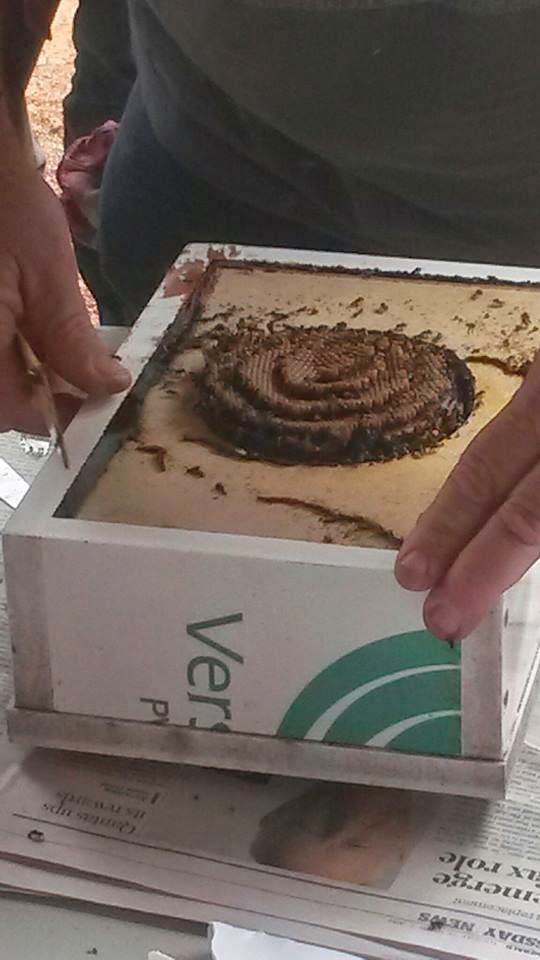
The bottom half
If you're inspired (and I hope you are!) Tim's website is full of great information, and his workshop was invaluable. John Klumpp's book Australian Stingless Bees also has lots of great information, and I highly recommend it.Now to find the perfect place for our hive while we are waiting for it to arrive!


