Thursday, 31 October 2013

October is for...taking it easy

I can never resist trying something new and exotic in my garden, so there's a lot of trial and error happening at our place. The real benefit of that is that I can share some of what does or doesn't work for me! For anyone just starting out growing veggies or whose choice is limited by space, here are my picks for the easiest veg to grow, so that you can make the most of your patch of earth with little effort.

Peas & beans  

If you have a little piece of ground and something to climb up, these are hands down the easiest veg to grow, and super productive too. Best grown from seed, just poke them a centimetre or 2 under the ground, water and wait. They say if you soak the seeds in water overnight before planting you will get better germination, but I'm not one to plan far enough ahead to manage it, and the little fellas always come up! Snow peas especially cost a fortune to buy fresh, but they are so easy I can't believe everyone doesn't grow them. PS. Grow peas in cold months, beans in hot ones. PPS. These don't even need much fertiliser- they are legumes and take Nitrogen from the air and put it in the soil. Very clever.

Silverbeet
A great option for spinach lovers that live in warm or dry areas, as English spinach needs cool moist areas to grow nicely. Silverbeet has loads of flavour and is incredibly good for you, I tend to chop it up and add it to just about anything I'm cooking. These days you can find varieties that have different coloured stems, in white, yellow, orange, pink and red, and some of the leaves colour up as well. I find the rainbow mixes just gorgeous in the garden, as well as delicious. The plants are quite long lasting- I grow a new row every 6 months but they can last a year or more if you water them every now and then, and cut the leaves from the outside as you need them.

 Cherry tomatoes
Most tomatoes are easy to grow and the flavour is well worth the effort, but the smaller fruiting ones are so hardy they often pop up on their own. Easy to eat too, you can just munch on them while watering the garden, throw them in a salad or roast them whole. Because the fruit is smaller, they don't need staking and often escape the dreaded fruit fly. Kids love to collect and eat them too, so try enticing a fussy eater into the garden with you and see what happens! 

Beetroot
A very under-rated vegetable, beetroots are a staple in the garden at our place, and grow almost year-round. I just put them in the ground, and 2 or 3 months later their round tops are bursting out of the soil, asking to be eaten.The beets themselves are wonderful pickled or roasted, and the leaves can be cooked up like spinach when you pull up the roots. There are a few different colours of these available too, and I think the white ones are the sweetest.

  Corn
Sweetness and flavour are great incentives to grow your own, as the sugar starts to turn into starch straight after picking. Corn is wind pollinated, so it's best to grow it in blocks rather than rows, to make sure you get full cobs. Other than that, just poke the seed into the ground and watch it grow. They are ready when the cobs feel full and the kernels are yellow if you peek under the husk.


   Cucumber
In summer we go through so many cucumbers in salads, wraps and sandwiches. I like to grow the Lebanese cucumbers because the size is convenient, but there are all sorts of shapes and sizes around if you look. They can be a bit rampant if grown on the ground, so they are best given a strong trellis to climb. If you are in a cool moist area they can be a bit prone to mildew, but it's not usually a problem here. You can spray the vine with a milk mixture to keep mildew at bay if you need a safe remedy. If you don't have something for them to climb, zucchini grow on the ground and are just as simple. Just make sure you pick them while they are small, otherwise you will find zucchinis as big as your arm hiding in your veggie patch!

If you don't have much time to devote to your garden or don't know where to start, try some of these. There are so many options available and I can't help wanting to try them all, but in my experience they are the easiest to grow and the most rewarding with plenty of produce. I'm still trying some new plants this summer, and have some chickpeas and mini pumpkins growing, plus some unusual varieties of the old favourite tomatoes, eggplants, zucchini and squash. I will let you know how they go!

Saturday, 12 October 2013

Photo of the week - Friend or foe?

Put on your detective hats people, I need help identifying this!


They were here when we moved in, and have little spotty lily-like leaves. The flowers are only recent, and they remind me somewhat of Muscari or Lachenalia, with a bulb like a bluebell. So I'm pretty sure it's from the Asparagus family, but I can't get any further than that! It's not in my weed book, which makes me happy, but did survive when we sprayed the couch there with roundup, which makes me nervous! I'd like to leave them there because they are so sweet, the little flowers are less than 10cm tall and have a perfect spiral pattern that has me in mind of Fibonacci and my maths days.
 
 
If you can solve my mystery, do let me know! If they are weeds I'll have to get rid of them, perfectly patterned flowers or not! If not, they can continue to grow happily under the rosemary.

Friday, 4 October 2013

Nerd alert: Friends in the garden

Now that I do an extra 2 hours of travelling to work and back every day, I'm getting home after dark, which leaves me no time to do my usual garden scouting (watering, checking for pests and diseases, looking for new fruit/flowers, and seeing what's ready to eat). The upside of this is that I get up excited on the weekend to see the changes in the garden over the week. One Saturday this month I was picking the caterpillars off my Tuscan kale (as you do...) when I noticed that one looked a bit suspicious! He wasn't moving, had some yucky black spots on him, and was laying on a pile of yellow cushions. There was also a little black insect sitting nearby.

Apanteles glomerata adult and pupae

I'm quite familiar with these caterpillars, they are the larvae of the white cabbage butterfly (Pieris rapae) and they eat big holes in the leaves of brassicas. I've seen the butterflies flitting about my broccoli and kale, laying tiny little yellow eggs, and I've washed them off when cleaning the leaves to eat. So I know they are as small as a pinprick, not big and fluffy like these things.
I've also studied some entomology as part of my horticulture degree, enough to recognise the little black critter as a tiny wasp. They are closely related to ants, and have a similar body shape with 3 distinct segments.
After a bit of research, I've discovered the wasp is a parasite called Apanteles glomerata, who lays her eggs inside caterpillars. After hatching, the baby wasps eat their way out of the offending caterpillar, and spin little yellow cocoons. When they come out of the cocoons, they are fully developed wasps (albeit very small) who will find a mate, and then an unlucky caterpillar. Although it's a grisly way to feed your children, it's quite handy for me, as wasps like these control the numbers of caterpillars in my veggies so that there are more for me to eat.
For me, the moral of the story is this- not using pesticides in my garden means safety for the insects that are actually helping me out. I hope the wasps that come out of these cocoons hang around my garden and find every one of those pesky caterpillars! It's a beautiful system (in a disgusting way) and I'd hate to interfere.

Saturday, 28 September 2013

September is for... celebrating in style!

Guess what?! This month we celebrated our home-owner-versary! I'm so excited about this little milestone, and thought it must be time to recap and take stock of some improvements we've made to the house and garden. I'd also like to take the opportunity to start posting a 'photo of the week' because sometimes I just can't wait to show you what's happening, and they will be short and 'snappy' I promise! There will still be a monthly update for those who love a good story.

So here are my top 5 'before and after' transformations, 2 of which are still in progress, and you will be getting an exclusive sneak peek!

1. The hallway/spare bedroom:
A work in progress, but a fantastic result already. Originally the house had 2 living areas, but only 1 decent bedroom (I don't count the 'study' as a bedroom as it wouldn't fit much more than a bed and desk in it!). We decided to put up a wall to separate off the front room and turn it into a usable spare bedroom. This also gives us a nice hallway area to draw people toward the lounge room and kitchen.


2.The driveway garden/veggie beds:
Recycling the old fence panels has been great fun, using them as supports for our vegetables along the driveway fence. Tomatoes, eggplants, peas and beans have all grown up them, with room for a row of greens, herbs or root veg in front. We now have these running right from the front fence, with some dwarf citrus and apple trees between each. You will have to use your imagination a bit for the veggie beds, as I've just planted my summer seeds and they haven't done much yet!


3. Down with the carport:
Even though we are on a good sized block, much of it is unusable for garden space due to the layout. The garage is at the back, requiring a long driveway, and the pool is directly behind the house. We decided the garage and driveway provide enough parking space, and the carport was just collecting 'stuff' that we didn't need anyway. Full story to come when the project is finished! 


4. The pool area:
Removing the awful old fencing was quite a job, but it made such a massive difference. The yard is now open and full of light, and the garden has made it a lovely place to lounge about or sit and read.


5. The front garden:
The aim here was to dress up the 'face' of the house to increase street appeal, so the big dark fence was first to go. A mixture of softening flowers, native plants and roses make the house feel loved, and 2 deciduous fruit trees where planted in the lawn to shade the western bedroom windows in summer, and let in some sun in winter.


It's been a big year, and hopefully next year will see house and garden get even better. Stay tuned for updates on the carport/new garden and spare room!

Saturday, 31 August 2013

August is for... seeing the light at the end of the tunnel

 
Where I live, winter says goodbye in such a spectacular way- the roadsides and bushland are lit up by gorgeous golden wattle flowers. The show starts in July and by the end of winter the glow is a heartwarming promise of spring.


I love native plants, and have been learning more about them over the last 6 years of my environmental horticulture degree. My inner botanist has come out this year, and I've decided I'd like to know which species are lighting up my world. That's right, they're not all the same! I remember the days of thinking a wattle is a wattle, and recently realising there are hundreds of Acacias right under my nose has sparked my curiosity.


The differences between species are usually found in the number, location and shape of features such as flowers, glands and phyllodes (almost leaves but not quite!).The trick with identifying Acacia species is that they can be difficult to tell apart when they're not flowering, so it has to be done while all their fluffy flower heads are on show. But I work full time, and study in my 'free' time, so I know I'm not going to get around to naming them within the next month or so. 

I think it was my older sister who showed me how to press flowers in phone books when I was young, and I found it fascinating to preserve flowers to keep. My botany teacher thought it was a bit unorthodox, but he didn't complain about the pressed specimens I handed in for assignments (real botanists use presses that you can pack with layers and tighten with straps, but I'm still very much an amateur!).

Luckily my new job has a focus on local native plants and a bookcase full of great information (it's plant nerd paradise!) so I have been cutting off pieces along the roadside and taking them in for some help, before bringing them home to find a place in my phone book. Some have been easy, some will have to wait until I have time to have a closer look, but so far I have collected flowers from about 22 species. And there are still more that haven't come into flower yet! And yes, I do get some strange looks from other motorists when stopping suddenly on the highway and jumping out into the bushes, secateurs in hand. I tell myself Joseph Banks would understand.


Now the tricky question is- which ones do I have room for in my little garden?

 My choice would have to be the lovely Acacia decora, a pretty little weepy shrub growing to about 1.5 metres. Or Acacia amblygona... the scrambling wattle, with its prickly little leaves for wrens and finches to hide in. Or maybe both. We will have to see how much room we have... that carport will have to go, sooner or later...

And now for a bit of self-indulgence, a selection of photos from around my garden this month. I've been trying out my new macro lens and it's a joy to work with, especially with all the lovely spring buds just beginning to burst. Enjoy!

                            Native everlasting (probably Helichrysum bracteata, I don't remember!)

Broad bean 'Aquadulce' 
 
Lemonade flowers

Purple sage

Snow peas

Tuscan kale or cavolo nero

                                                       Leptospermum 'Cardwell'

Kangaroo paw Anigozanthos 'Bush diamond'

Wednesday, 31 July 2013

July is for... shedding the old leaves


Winter is such an interesting time in the garden- as much as I hate the cold, I love the brightness that come from seeing the deciduous trees back to their bare bones and the extra sunlight that finds its way through. Not to mention the free mulch you get if you collect up all the old leaves! They are absolute gold and should never be wasted by throwing them in the bin or the burn pile!

This month has been a big one for me, as I have done some shedding of my own and resigned from my job of 4 years working in a display garden nearby. As sad as it has been, I know it's just another season in my life that needed to make way for what is to come next. I'll be doing work that is closer to my heart, at a nursery that sells nearly all native plants to home gardeners, farmers and some bigger revegetation sites of old coalmines and farmland. I'm really excited to get to know better all the plants that grow naturally around the area, what their needs are and how they can be best used. I am happiest when I'm learning something new, especially when it's contributing to the bigger picture of conservation and rehabilitation. And driving to work past the mines and power stations makes me glad to be helping the environment in my small way.

So be prepared to be introduced to the lucky plants I bring home to our little patch of earth, I always struggle to control myself around interesting plants and now I am surrounded by them every day! oh dear!


As if I needed any encouragement- a few weeks ago I picked up a couple of dwarf apple trees to plant- a Granny Smith and a Pink Lady, which should pollinate each other. They are lovely bare skeletons at the moment and I can't wait to see them burst out in spring. Maybe the anticipation of spring is the best part of winter!

This month was also my birthday, and I was lucky enough to be given a beautiful weeping Grevillea bipinnatafida. I haven't decided where to plant it yet as I'm not sure if it can be next to the pool fence or not, but I will take a nice picture when it finds a permanent home.


The veggies are pumping and the first snow peas will be ready within a week, we have been eating carrots, kale and silverbeet regularly and the broad beans, broccoli, fennel and sugarsnap peas are making good progress. I can't wait to sink my teeth into them! The first asparagus spear also came up this week- a sure sign that spring is not far away!


P.S. I upgraded to a better camera this month, so if anybody actually noticed the better quality photos, I'd love to know!


Sunday, 30 June 2013

June is for...trying to keep warm

Since we moved into the house last spring, we've had an issue with the hot water system. It's an electric instantaneous heater that sits under our sink in the kitchen, and heats water 'on demand'. Unfortunately ours is quite temperamental and would heat the water to whatever temperature it deemed appropriate (cool, warm, or scalding hot) and cut out at some point during your shower (often at the least convenient time, like when your hair is full of shampoo). Over summer it wasn't a big priority, as a cool shower is often a great way to end a hot day of gardening. But as the days have been getting cooler we have been saving our pennies, and we now have a lovely new gas hot water system installed by Matt's uncle Grahme. I can't express to you the joy of having a reliably hot shower in winter, and it's a luxury I will never again take for granted! In times when the water went cold in the shower I told myself that we were lucky to even have running water, and it has helped me to be more grateful for everything we have. Our little house is nothing fancy, but it is getting better all the time and it's so satisfying to see the improvement. I now have a month off uni before finishing my final semester and becoming a 'real' horticulturist, so hopefully we will make lots of progress over the coming weeks. I have also learned that painting walls is a great way to keep warm on a cold night, killing two birds with one stone!


The garden beds around the pool have finally been finished off, with a grafted standard Casuarina glauca 'Cousin it' which looks like something out of a Dr Suess story, a few more kangaroo paws and lomandra 'Shara'. Some sandstone stepping stones lead out onto the lawn, and our 3 waterlily bowls make use of an odd triangle of concrete that looked tricky to remove.


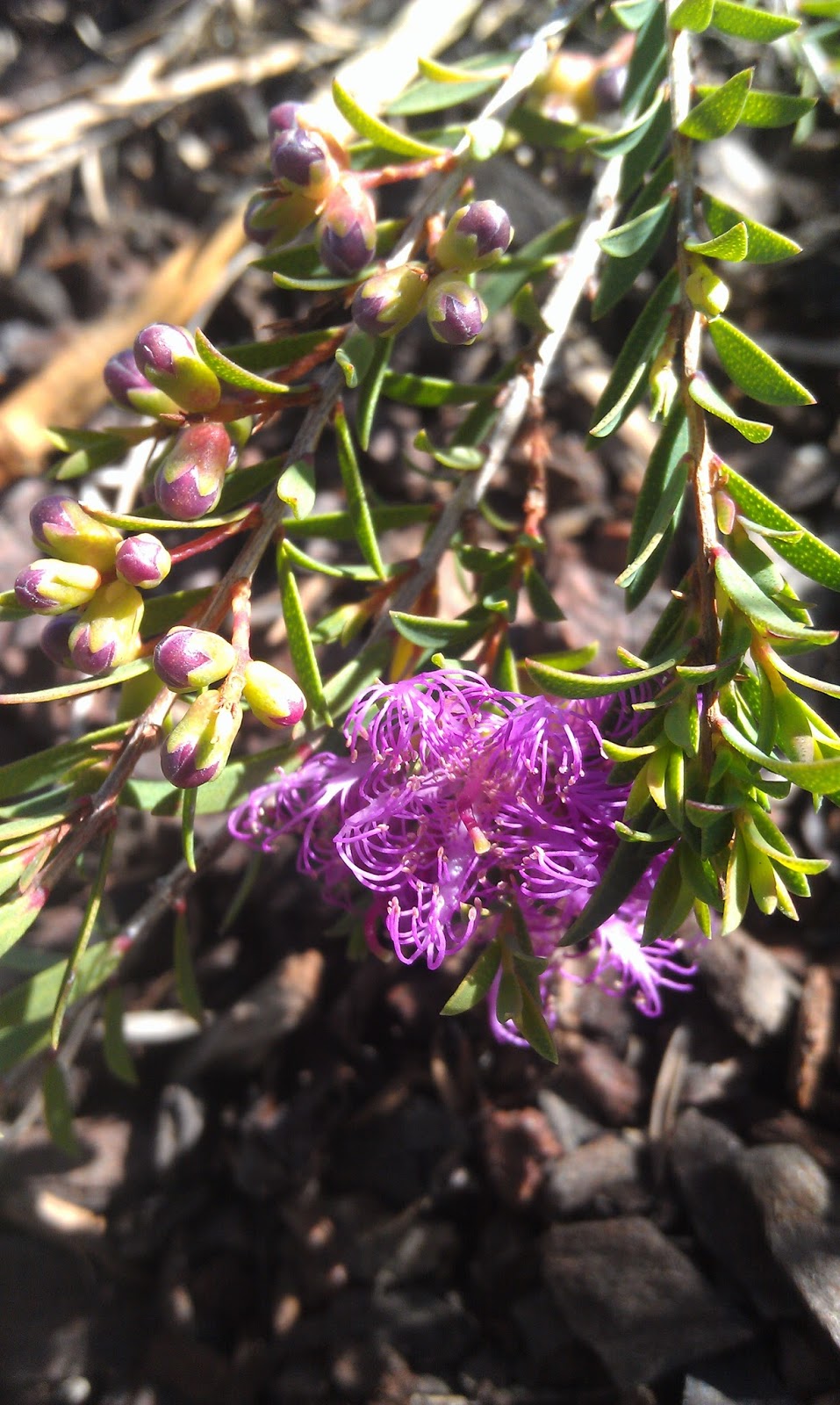
We had to remove the Acacia 'Limelight' that didn't survive the summer, but found a gorgeous Melaleuca thymifolia to replace it. It's a groundcover form called 'Little Beauty' and has the sweetest little purple flowers!


 Along the shorter side of the fence there is a simple row of rosemary, as I love to use it in the kitchen and my 2 little plants just can't keep up with the demand. Bees and other insects love blue, so the little blue flowers should encourage more pollinators and some beneficial predators to hang around. As an added bonus, I managed to grow all the rosemary from cuttings, so this section of the garden was FREE! Rosemary, lavender and the rest of the mint family grow really well from cuttings, so it's really worth the little bit of effort for the satisfaction of making your own little plants. For these, I just cut off a piece about 15cm long, stripped off two thirds of the foliage and buried them in potting mix at least halfway up. This helps to keep them steady and maximises the amount of stem that can form roots. Water them in well and then keep them damp (but not wet) until you can feel some resistance if you pull them gently. If you just happen to have some cutting hormone (in the form of powder, gel or liquid) these will help to improve your success rate, but aren't absolutely necessary. I've heard of people dipping their cuttings in organic honey and then cinnamon powder to encourage roots to form, but haven't tried it myself. Sounds like a good experiment!