Since we moved into the house last spring, we've had an issue with the hot water system. It's an electric instantaneous heater that sits under our sink in the kitchen, and heats water 'on demand'. Unfortunately ours is quite temperamental and would heat the water to whatever temperature it deemed appropriate (cool, warm, or scalding hot) and cut out at some point during your shower (often at the least convenient time, like when your hair is full of shampoo). Over summer it wasn't a big priority, as a cool shower is often a great way to end a hot day of gardening. But as the days have been getting cooler we have been saving our pennies, and we now have a lovely new gas hot water system installed by Matt's uncle Grahme. I can't express to you the joy of having a reliably hot shower in winter, and it's a luxury I will never again take for granted! In times when the water went cold in the shower I told myself that we were lucky to even have running water, and it has helped me to be more grateful for everything we have. Our little house is nothing fancy, but it is getting better all the time and it's so satisfying to see the improvement. I now have a month off uni before finishing my final semester and becoming a 'real' horticulturist, so hopefully we will make lots of progress over the coming weeks. I have also learned that painting walls is a great way to keep warm on a cold night, killing two birds with one stone!


The garden beds around the pool have finally been finished off, with a grafted standard Casuarina glauca 'Cousin it' which looks like something out of a Dr Suess story, a few more kangaroo paws and lomandra 'Shara'. Some sandstone stepping stones lead out onto the lawn, and our 3 waterlily bowls make use of an odd triangle of concrete that looked tricky to remove.
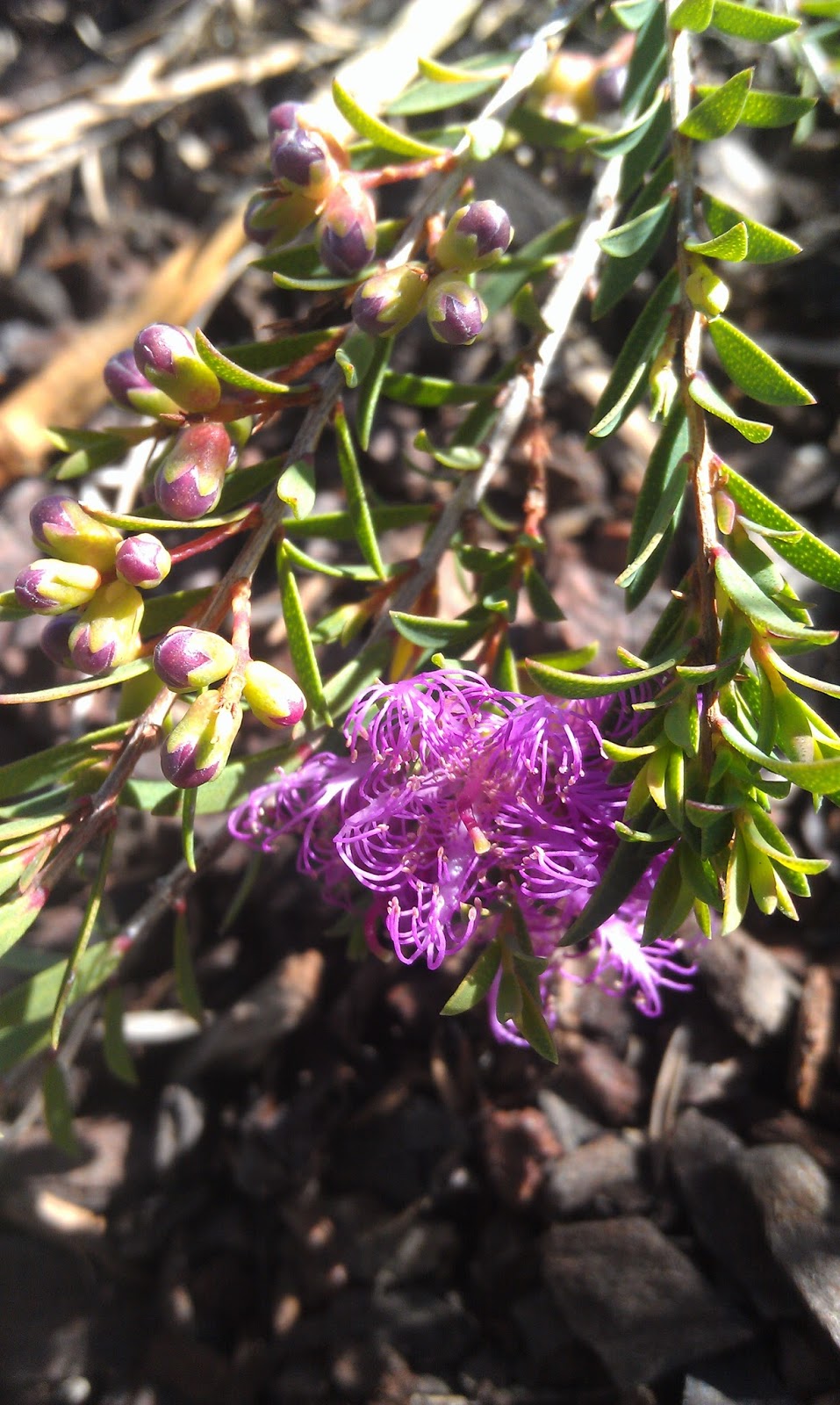
We had to remove the Acacia 'Limelight' that didn't survive the summer, but found a gorgeous Melaleuca thymifolia to replace it. It's a groundcover form called 'Little Beauty' and has the sweetest little purple flowers!
Along the shorter side of the fence there is a simple row of rosemary, as I love to use it in the kitchen and my 2 little plants just can't keep up with the demand. Bees and other insects love blue, so the little blue flowers should encourage more pollinators and some beneficial predators to hang around. As an added bonus, I managed to grow all the rosemary from cuttings, so this section of the garden was FREE! Rosemary, lavender and the rest of the mint family grow really well from cuttings, so it's really worth the little bit of effort for the satisfaction of making your own little plants. For these, I just cut off a piece about 15cm long, stripped off two thirds of the foliage and buried them in potting mix at least halfway up. This helps to keep them steady and maximises the amount of stem that can form roots. Water them in well and then keep them damp (but not wet) until you can feel some resistance if you pull them gently. If you just happen to have some cutting hormone (in the form of powder, gel or liquid) these will help to improve your success rate, but aren't absolutely necessary. I've heard of people dipping their cuttings in organic honey and then cinnamon powder to encourage roots to form, but haven't tried it myself. Sounds like a good experiment!
I have a confession to make. I've been accused of being grassist. In general I can find something to appreciate about most of creation, and plants especially, but for a long time grasses have left me cold. It's just that I find their strappy leaves predictable, the lack of colourful flowers a bit uninspiring, and most of them you can't even eat! Part of the problem is that I feel like grasses and grassy looking plants are overused in 'modern' or 'low maintenace' gardens without much thought going into the combination or design. Once my garden discrimination was pointed out, I felt the need to find some sort of common ground with grasses so that I could better appreciate their unique qualities. Over the last couple of months, a few major benefits have come to light.
1. Finch food
One main objective of our garden design is its ability to attract and feed birds. I have a couple of wonderful books to guide me; my favourite being 'Birdscaping Australian gardens' by George Adams. I've learned that different birds all eat different food, whether insects, fruit, seeds, nectar or other garden goodies. To provide for a variety of birds, I will need a variety of plants. Simple, right?
At work I have been taking more notice of where I see my favourite birds regularly visiting. The white-plumed honeyeaters and eastern spinebills seem to love chinese lanterns and salvias at this time of year, and the blue wrens, silvereyes and yellow thornbills seem to form mixed groups, hunting ferociously in dense bushes where the best little bugs hide. The red-browed finches and double-barred finches, however, feed in flocks as they carpet the ground, eating grass seeds in the open areas. I have seen a couple pass through my garden at home, stopping only for a drink in my little waterbowl. I would hate for them to feel left out of the grand plan!
2. Pool maintenance
My next project is the garden that edges the pool area, now that the fence is up. Now as much as I love being outside, cleaning the pool is really not my thing. We have a great gadget that crawls around on the bottom vacuuming everything up. He's not perfect, however, and I'd like to make his life as easy as possible by not planting things around the pool that will drop too much leaf or flower matter into it. Most grasses will be perfect for the pool area, I just need to avoid any with big fluffy seed heads.
Anigozanthos 'Bush Diamond'
And so, I began shopping around for plants with just the right attributes. My first choice was a lovely kangaroo paw that has been catching my eye around the nurseries lately, called Bush Diamond. Its velvety white flower is held above the strappy leaves to bring a bit of brightness to the garden and attract nectar feeding birds.
Anigozanthos 'Bush Pearl'
I also bought a few pots of Bush Pearl, its cool pink cousin, to add colour, and the taller black kangaroo paw for some height in the back corner. Aiming for a cool palette, the silver-blue Festuca was a must. Small and feathery, it will be mass planted to tie the whole garden together. Lomandra 'Shara' is a native that looks a bit like a larger version of the Festuca, so I will use it to fill out and accent areas.
Festuca glauca
To soften the effect of all those spiky leaves, I have made sure to plant in curves and waves, and have also added some mound-forming native plants for their lovely rounded shape. Acacia 'Limelight', Banksia 'Rollercoaster' and a lovely endangered plant called Zieria 'Carpet Star' will be dotted singly through the bed.
Zieria 'Carpet Star'
Banksia integrifolia 'Rollercoaster'
As per usual the month has flown by and I would have loved to include a finished photo of the bed, but January has somehow escaped me and it is not yet complete (a good gardener knows that a garden is never finished!). I will include a finished photo as soon as possible, until then I will leave the rest to your imagination...


