Saturday, 7 March 2015

Introducing the 'blue bullet'!

On Saturdays I finish work earlier and have a bit of extra time before it gets dark, to see how the garden is faring. Today I took the camera out, because I happened to notice between car and house that my new Grevillea Dorothy Gordon has its first flower! How exciting... it's a new release and I can't resist Grevilleas in the pink/purple colour range, especially when they promise a long flowering season! It's so great to see one in real life, and loaded with nectar too. Worth every cent, don't you think?


One job done, I went to explore the back native garden which is coming along nicely after removal of a rampant Kennedia nigricans (lovely but too big for my space) that had swamped a few of the smaller plants. There are a couple of empty patches of ground now, and I'd noticed when weeding a few weeks ago that there were heaps of white curl grubs in the soil. They eat roots you see, so most people know them as lawn grubs, who munch the roots of plants or grass below the ground until the plant gives up and simply dies. If your lawn is affected, it can simply roll up like carpet once the roots are all eaten.


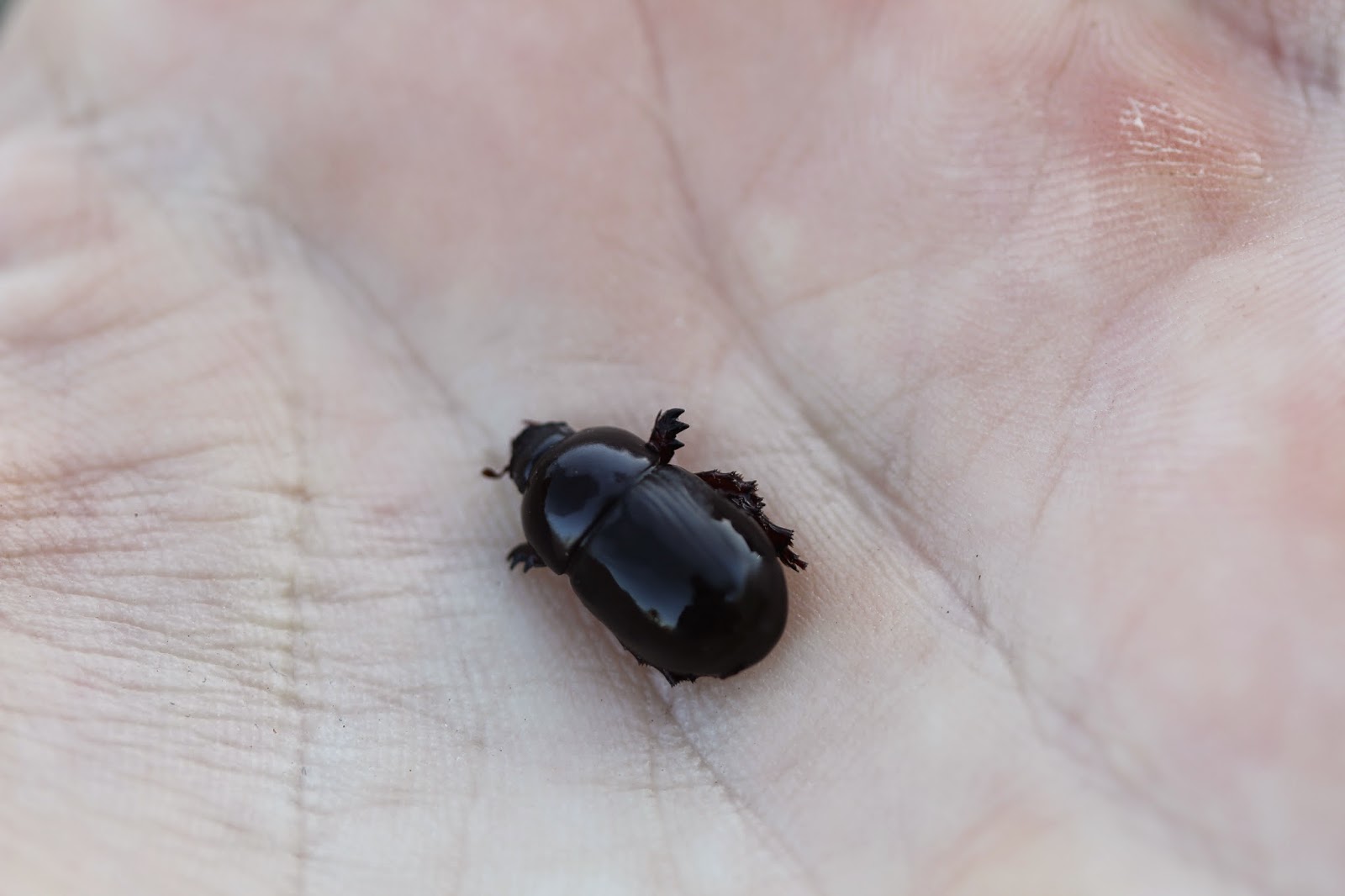
 The culprits are larvae of the pest African Black Beetle Heteronychus arator, who is often attracted to backyards with solar lights or security lights on during the night. They congregate around the lights, and lay their eggs in your garden, lawn or plant pots.

 
I was really excited this afternoon to have my exploring interrupted by a huge black insect with shiny blue wings flying at me- enter the Black Flower Wasp, Discolia soror! At work we used to call these Blue Bullets, which describes their size, shape and colour pretty well.


They seem oblivious to humans and fly around you unafraid and at great speed, eventually landing on the ground. If you're lucky, like I was...you might see her start digging in empty patches of ground, and come up a minute or so later. The beautiful part is, she's hunting for curl grubs to lay her eggs on, so her babies will eat them for me. As the saying goes... my enemy's enemy is my friend...


This is the first time I've seen one here, and I'm hoping it's because of the flowering natives I've planted for the birds and bees to feed on (these  native wasps feed on nectar as adults and are also useful pollinators). Hopefully as my garden grows I'll attract plenty more so I don't have to use any nasty lawn grub chemicals!

As an extra nerdy treat, I also saw this wasp which I think is the male Hairy Yellow Flower Wasp Campsomeris sp, resting on my lemon grass. It performs a similar function, but I haven't seen them before at all. Will have to do some more research, the biodiversity  here is increasing all the time!


Sunday, 1 March 2015

Busy bees

The end of the year was as it always is - a hectic and joyful scurrying filled with love, tears, gifts, goodbyes and many late nights. The beginning of the year was likewise, with fresh starts, changes, and choices.

It's now the first day of March and I finally feel that I've caught my breath and my words will not just fall to the ground.

During a family trip to Queensland in December, I collected my bees. After waiting months, there was finally a strong hive with my name on it!


I tend to be intimidated by cities, and imagine them to be places devoid of natural life. What a delight to pick up my hive from right in Brisbane, surrounded by multi-lane highways and towering buildings. Of course there was enough plant life to sustain the hive, but I found it strangely encouraging to think of them navigating the streets and finding it as awkward as I do... but succeeding nonetheless.
 

They MUST be happier at my place though, right?! The bees were keen to get exploring the morning after they arrived in their new home, with a few early morning adventurers popping out of the entry before I left for work. They darted about for a while, flying backwards with their faces toward the hive to get their bearings.


By the time I got home at 6pm, they were busily coming and going, with saddlebags full of pollen. I grow a wide variety of flowers, herbs, vegetables and natives, but I am yet to spot one of the bees foraging on flowers in my own yard! The European honeybees seem to dominate the fennel flowers that I left especially for my little Tetragonula, so I have just planted some of the rocket that first brought them to my attention, just to make sure they don't have to travel too far (and also because it's delicious!).


I had a small panic on a hot day when I noticed a smell coming from the hive, and saw a bee wrestle out a small maggot from the entry. There are a few nasty pests to look out for, and a couple are flies whose larvae infiltrate the hive and can cause a lot of damage. Other bee nerds have reassured me that my 'sweet, tangy and slightly composty' smell is normal, and as I've seen no other maggots being ejected from the hive since, that's actually a  sign that the security guard bees are doing their job.

Guard bees surrounding the hive entry

Today it's 37 degrees, so I've soaked a towel in water and draped it over the box to keep it cooler. On hot days, it's so nice to sit by the pool next the hive and hear the faint hum as their wings work to cool the hive. It's almost like a contented purr.

Thursday, 12 February 2015

Game time!

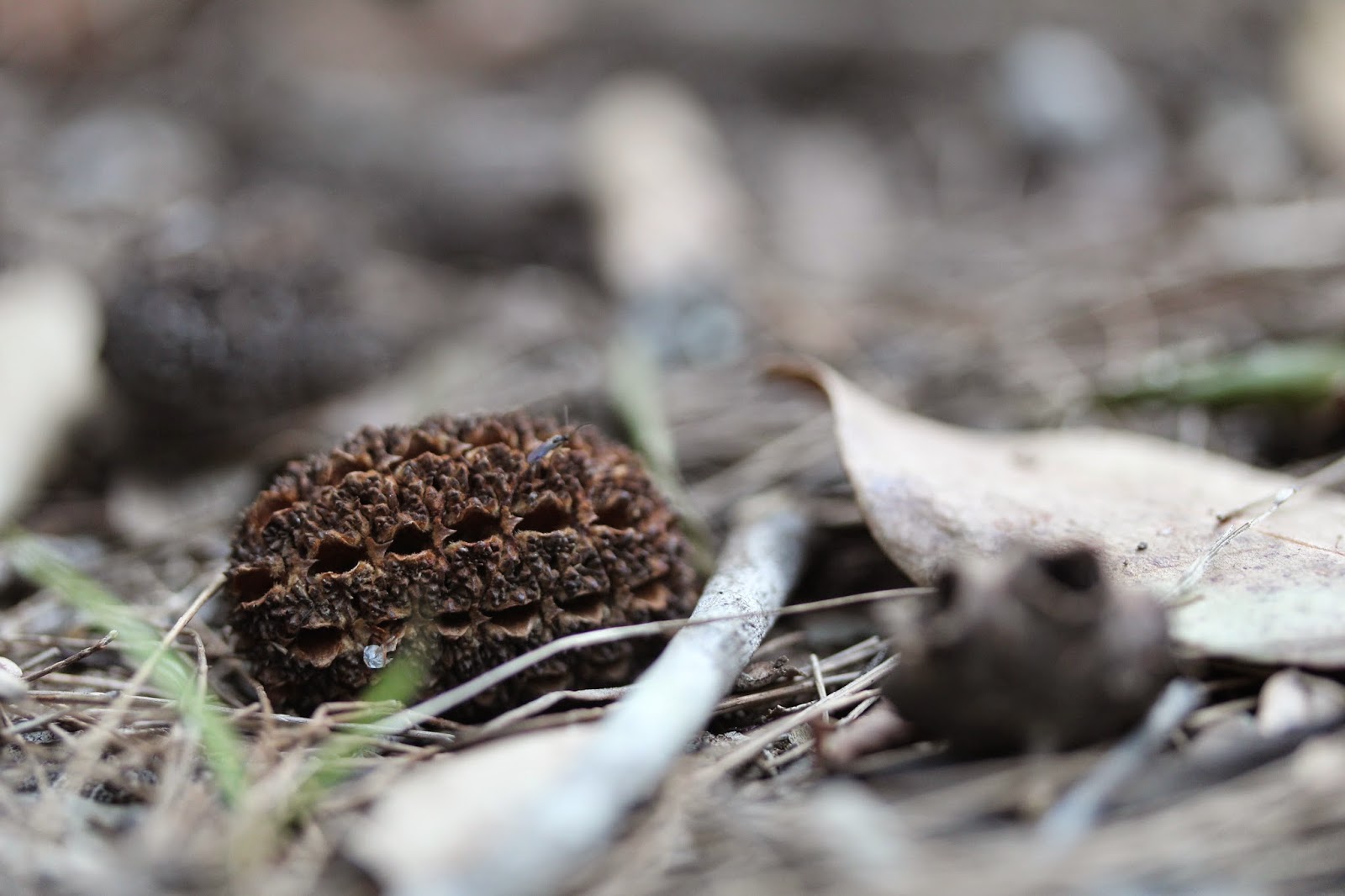
Anyone want to guess what these are?
You can click on the picture for a larger image.

 
Collected last weekend in Pokolbin NSW
 
No prizes except bragging rights! (I may have a clue or 2 up my sleeve).
 
UPDATE:
This is what the next stage will look like:
 
 
And then this! Crinum pedunculatum, or Crinum Lily. 


Sunday, 1 February 2015

Mauve Monday

Today ventured out into the garden to see what's flowering after all the rain we've had, and I'm noticing a theme... deja vu anyone?
 
I've heard that flowers in this colour range are great for attracting insects (and therefore insect-eating birds) and the insect diversity definitely seems to be increasing, so I must be doing something right!
 
 
Melaleuca decussata
  
Melaleuca thymifolia
 
Lagerstroemia hybrid
 
Allium sp.
 

Saturday, 20 December 2014

Bearing fruit

 
Tasted the first apricot from the tree yesterday...
 
So good.

Sunday, 14 December 2014

Photo of the week - Joy to the World

Clematis aristata is commonly called Travellers' Joy and flowers in the spring, then carries these delightful twirly seed heads through Summer. It's a climber that twines over shrubs and small trees, with glossy heart-shaped leaves.
 
 
I'm in a carolling mood at this time of year, and can't help but look at them with joy myself while collecting the seeds for the next generation of fluffy beauties!
 

Thursday, 4 December 2014

Wattleseed haiku

It's quiet and hot.
The office is alive, though,
with sounds of freedom

Triumphant crackles
As seed pods twist and tighten
Splitting at their seams

The dry husks make way
Exposing a glint of life
A seed of new hope


Friday, 31 October 2014

Forest finds

A weekend away a few weeks ago was a great re-charge with family in the forest at Telegraph Point on the Mid North Coast of NSW. This is the scene of campfires and fireflies, both of which I didn't even try to photograph!

I've decided my favourite time for natural photography is late afternoon (and on this day I finally learned how to turn my camera's flash off). My Oma was also there and said that Opa used to call this time of day 'golditops' when they lived in the bush, since the tips of the trees catch all the light as the sun goes down.

Here are some precious finds.


I don't know exactly what they all are, which adds a bit to the magic of discovery!


Tuesday, 28 October 2014

Getting more than I bargained for...

I first saw white Waratahs for sale a few years ago when working at a local nursery, and I thought the flower must be the most elegant thing in the world! After we moved in, I just happened to find one when looking for windflowers in May 2013. Months of waiting ensued, as the plant took a little while to settle in, and then began forming a bud. I had high hopes for a first flower and would have been devastated if it had only produced leaves, but sure enough, the white started to show. I was not disappointed in the least.


Watching the flower unfurl slowly was magical enough, but I have been extra blessed to discover that the flower produced 2 more buds from within itself and gave me three for the price of one! 


This particular variety is called Shady Lady White, and is growing happily on the cool, shady southern side of the house. I've since invested in a Shady Lady Crimson to keep it company, and will wait equally patiently for those flowers! There is a yellow form as well, but it eludes me...for now.
 
I've always been taught that you should prune Waratahs back after flowering, but this one seems as though it has branched from right inside the flower, so I'm reluctant to cut the new 'branches' off.
 
Would you prune it back or let it grow?

Saturday, 11 October 2014

To bee or not to bee...

 
We've been enjoying some late brassicas as our spring greens, as the purple sprouting broccoli and Romanesco cauliflower become ready. Unfortunately for me, this means other plants in that family have given up growing leaves and have turned their attention to flowers in the heat, including our kale and rocket.


This year, it's actually been really exciting rather than disappointing to see this happening. Beauty is in the eye of the beholder after all! The flowers are edible and make a pretty garnish to a salad or stirfry, but it's the wider effect of the flowering that's really drawn my attention.


I've been doing some beekeeping research since my birthday in July, when we decided that bees would make a great addition to our home and garden. Thankfully there is a beekeeping shop and club nearby in Newcastle, but as luck had it, on the day we ventured out to buy our hive, the shop door closed right as we drove in. Not deterred, we went to a local bookshop and found a book on the subject instead. Here is where things got interesting, as I soon realised this was a major undertaking including checking the hive fortnightly (involving a full bee suit and smoker) and processing huge amounts of honey at just the right time... not to mention the fact that we're in a normal suburban street with neighbours on either side and swimming pools to deal with. Once I got to the section about swarms and stings I was pretty intimidated, but thought I might check out the Hunter Valley Amateur Beekeepers website for inspiration. There I found links to information about stingless bees, and all my problems were solved.


The Upsides:
 
1. Environmentally friendly
These stingless bees are Australian natives, and the species we are getting lives naturally in this area. This means there are no concerns about introducing more European bees into the area and the various problems they bring.
 
 
2. Low maintenance
It's best not to open your hive at all, except a year or two down the track if you want to split them to create more hives.


3. NO STINGS!
Just in case you missed the point earlier! Apparently they can bite you with their little jaws, but it's only if the hive is disturbed and not nearly as painful as a sting. This means no bee suit, no smoker, and no cranky neighbours.
 
 
4. Fewer pests and diseases
Many of the pests and diseases affecting European honey bees are not an issue for these little fellas, so you don't need to constantly be checking their hive. They are excellent guards, so many pests attempting to enter the hive are destroyed.
 
Tetragonula carbonaria (note the white fuzzy face)
 
The downsides:
 
1. Sensitive to extreme temperatures
The European honeybee can live and function at both higher and lower temperatures than many of the native bees. Tetragonula carbonaria are the species most commonly kept, and I wasn't sure they would survive here due to the cold winters. You can imagine my excitement when I saw them feeding on our rocket and kale, as they only forage 500m from the nest, that means they are alive and well, not far from here!


2. Lower honey production
European bees are so popular for their epic honey making ability, which outperforms the native bees by many times. A stingless bee hive may produce 1 to 1.5 kg of honey per year, provided the temperatures are suitable and there are plenty of flowers to collect honey and nectar from. This pales in comparison to honeybee hives, but is also more convenient to collect and process.
 
I'm convinced that they're a much better option for us, and we've ordered our first hive!
 
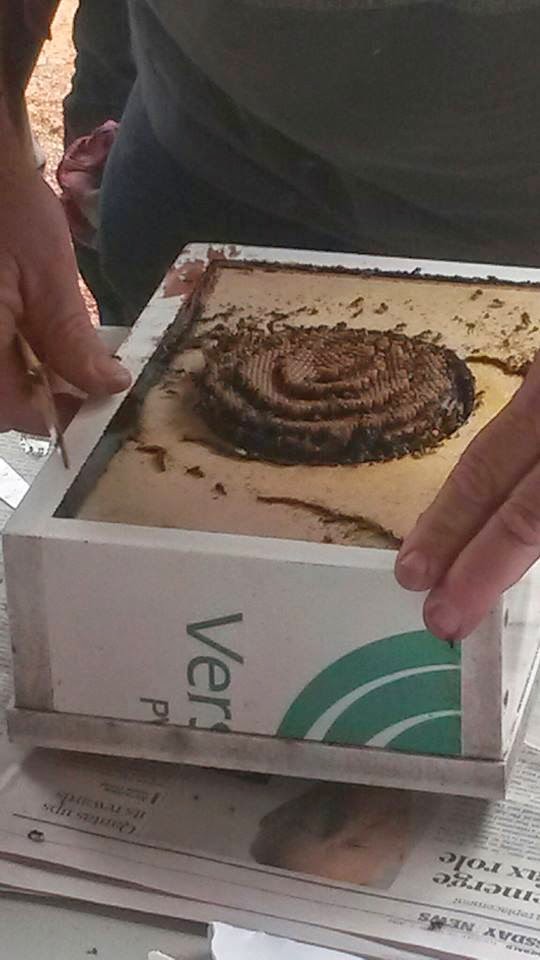
We attended a workshop this week with Tim Heard and Tony Goodrich to learn about the bees and how to keep them, and were all the more excited and inspired to meet our new 'pets'. Pictures were taken on a phone, so apologies for the quality, but that spiral hive is such a beautiful creation.
 
Tony demonstrating splitting a Tetragonula carbonaria hive.
 
 The top half of the hive
 
 The bottom half
 
If you're inspired (and I hope you are!) Tim's website is full of great information, and his workshop was invaluable. John Klumpp's book Australian Stingless Bees also has lots of great information, and I highly recommend it.

Now to find the perfect place for our hive while we are waiting for it to arrive!